Holotype – Holotype: BMNH 1946.1.18.13 (formerly BMNH 1865.5.4.166). in the British Natural History Museum.
Etymology – inornata – plain – referring to this species’ limited or lack of pattern.
“Described by Sir Andrew Smith from specimens collected from the army base outside the town of Graaff reinet, Eastern Cape province, South Africa in 1838“
Species history – Described by Sir Andrew Smith from specimens collected from the army base outside the town of Graaff reinet, Eastern Cape province, South Africa. No further specimens were collected until the 1980s when a specimen was found at the Mountain Zebra National Park, around 180 km east of Graff Reinett. Further specimens were collected by Professor Bill Branch from the Kompassberg region in the Sneeuwberg Mountains. Further surveys by Wits University in 2014 revealled a single animal after a week of searching. A survey in 2018 conducted by reptile specialists turned up three individuals in as many days, showing this species is locally rare and occurs in low abundance. FitzSimons described scale counts from a specimen he examined in the Transkei Museum from the Cathcart region of the Eastern Cape Province. This record has been rejected in the recent reptile atlasing projects, however, FitzSimon’s scale counts conform to other specimens and although the specimen has been lost, it may suggest that their range extends further east than currently stated.
Bitis inornata
Bitis inornata
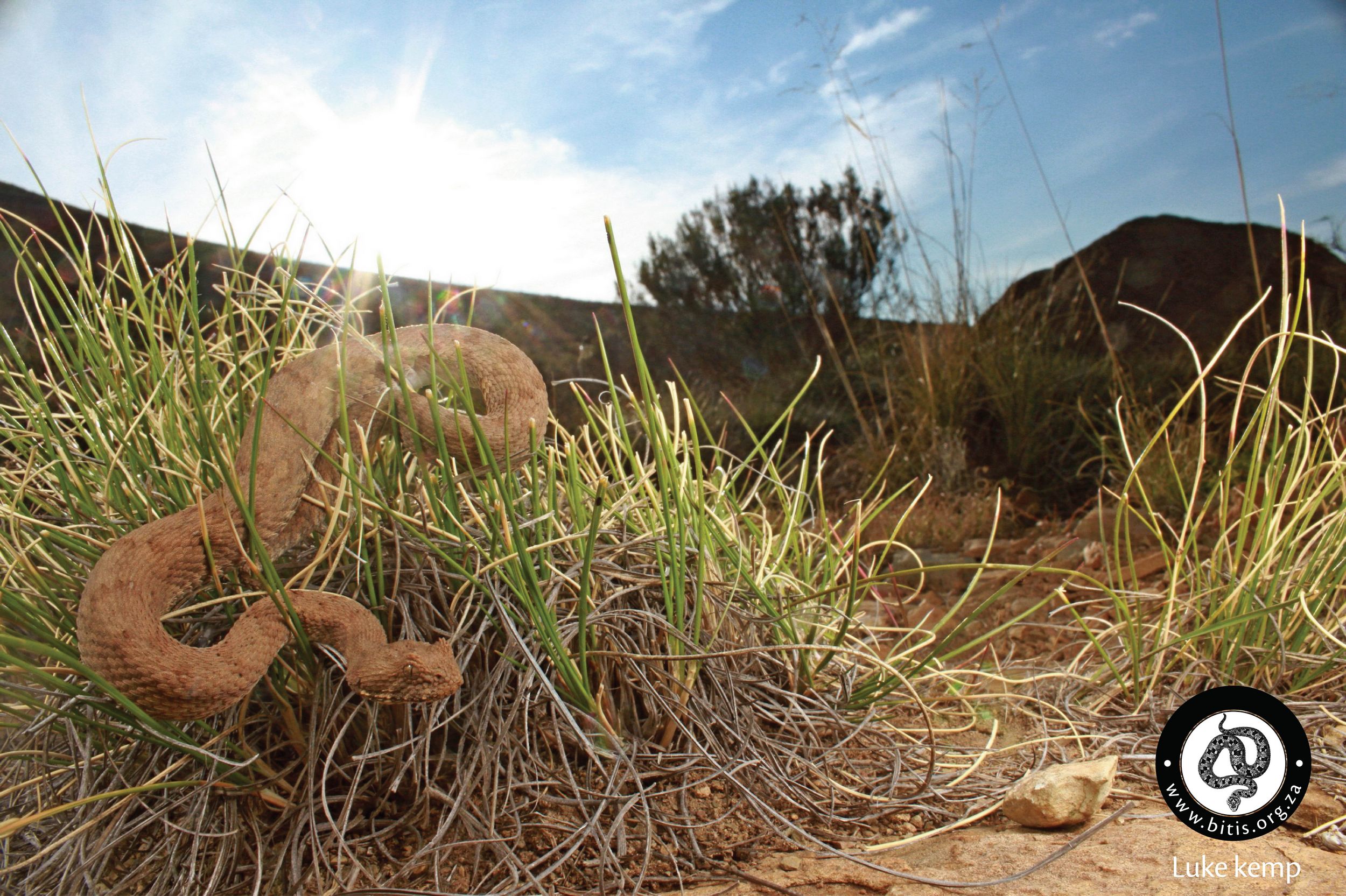
Description – As the name suggests this species is quite inornate in appearance, usually lacking in any meaningful patterning. Base colour is a light sandy brown and some individuals possess feint dorsal markings. These snakes have a small tuft of scales above each eye.
Natural habits – This species is a high altitude Bitis, occurring over 1500 meters elevation. It occurs in the grassland habitat of the Sneeuberg Mountains on grass slopes with scattered rock sheets. It appears active in the early mornings and probably early evenings, basking on paths and between grass tussocks and rock slabs.
Venom
Nothing is known about the venom of this species, though it is likely similar to that of Bitis rubida.